Dedicated bandwidth infrastructure.
Define network capacity around your traffic, billing model and application needs. Compare standard commitments, request 100 Gbps or unlimited-transfer terms and confirm exactly what your service agreement delivers.
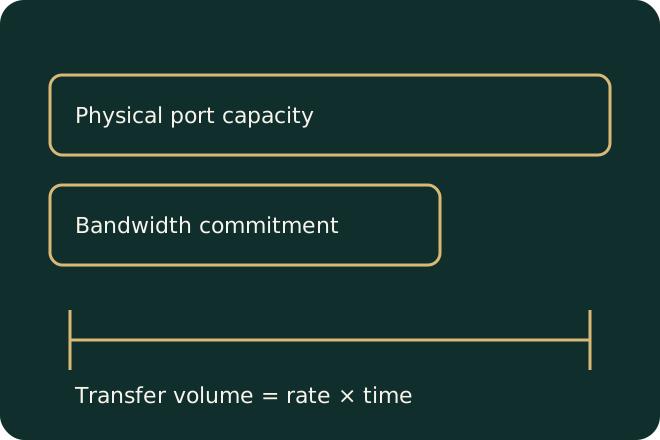
Separate the port, the commitment and the transfer volume.
A physical port sets an interface link rate. A bandwidth commitment describes an agreed traffic level or commercial allocation. Transfer volume records the amount of data moved over time. These are related, but they are not interchangeable. A fast port with a smaller commitment does not automatically include sustained use of the full link, and a large transfer allowance does not prove a dedicated path.
Ask what dedicated capacity means in your quote.
For a workload that needs predictable throughput, establish where capacity is reserved and how it is measured. Ask about the server interface, upstream allocation, traffic direction, oversubscription, contention and performance validation. The phrase dedicated bandwidth should describe a written service characteristic, not simply the fact that a server is single tenant.
Choose peak-based or 95th-percentile measurement.
Peak-based planning uses the highest observed rate according to the agreed method. A 95th-percentile calculation discards the highest 5% of ordered usage samples, then uses the next sample. It can accommodate occasional bursts, but it is not a discount based on average utilization. Confirm the sampling interval, inbound/outbound treatment, minimum commit and overage rate before ordering.
Understand unlimited-transfer offers.
Unlimited transfer is a volume term, not unlimited speed. Include the required sustained rate, burst pattern and traffic type when requesting an unlimited-transfer quote. Confirm the assigned port, capacity allocation and all applicable acceptable-use or usage restrictions in writing. Avoid comparing services only by the word unlimited when their available rate and terms differ.
Plan 100 Gbps as a complete deployment.
Sales enquiries for 100 Gbps and unlimited transfer can be submitted for any listed location. High-rate networking must be matched with the exact host, NIC capabilities, CPU, storage pipeline and network arrangements. Provide sustained throughput and packet-rate requirements as well as the port target. Custom pricing and delivery need confirmation; the standard online calculator remains limited to its verified matrix up to 40 Gbps.
Convert a rate into a useful transfer estimate.
At a constant 1 Gbps for 30 days, decimal data transfer is approximately 324 TB before protocol overhead. Multiply by the selected rate and average utilization to estimate application transfer volume. This calculation is useful for planning, but it cannot predict the billable peak or percentile from an average. Use measured samples when comparing billing models.
Create a network requirements brief.
Include customer networks, preferred cities, inbound and outbound demand, expected peaks, packet sizes and redundancy needs. Add any BGP, addressing, routing-policy or IP transit requirements as separate scope items. Confirm monitoring access, escalation contacts and the process for capacity changes. A clear brief makes quotations comparable and exposes assumptions before they affect production.
Bring your traffic requirements.
Share the workload, city, capacity and timeline you need.
Frequently asked questions.
What is the difference between port speed and bandwidth commitment?
Port speed is the interface link capacity. A bandwidth commitment is the traffic level or capacity agreed commercially. Neither alone proves an uncontended end-to-end throughput guarantee.
Can I request unlimited transfer across the listed locations?
Yes. Send Sales your preferred city and unlimited-transfer requirements. The quote must state port capacity, bandwidth allocation, price, permitted use and any limits before purchase.
How does 95th-percentile measurement work?
At an agreed sampling interval, usage samples are sorted and the highest 5% are excluded. The next highest sample determines the measured percentile. Sampling frequency, traffic direction and overage terms must be defined in the service agreement.